
BAO’AN DISTRICT, SHENZHEN — Shenzhen New Display Co., Ltd. (brand: HKSEBO) has been supplying TFT LCD, OLED and touch-integrated display modules to equipment manufacturers for more than a decade, with shipments now reaching customers in over 40 countries across Southeast Asia, Europe and North America, Japan and South Korea, and India. The company’s distinguishing asset is not the breadth of its catalogue but the depth of its customisation: backlights, FPC pinouts, touch stacks, driver boards and adapter PCBs are engineered to fit the customer’s enclosure and mainboard, rather than asking the customer to redesign around a standard panel.
Two factories, one engineering loop
New Display was established in 2014 in Bao’an District, Shenzhen, where its sales and development teams sit. Production runs through two facilities: Jinxian Electronics, a wholly owned subsidiary handling LCD production plus touch panel and cover glass lamination, and Sebo Optoelectronics, a joint venture producing LCD modules and flexible OLED displays. Together they operate 1+3 automotive-grade production lines, with output capability measured in the hundreds of thousands of pieces per month. The company holds ISO 9001 system certification and Shenzhen High-Tech Enterprise status.
The structural point is worth stating plainly, because it explains why custom work at this company does not stall. Most display trading houses can quote a standard module within a day, but the moment a project needs a different backlight, a re-pinned FPC or a cover glass with a specific surface treatment, that module leaves the building and enters somebody else’s queue. At New Display, lamination, module assembly and electrical verification happen inside the same group. A custom backlight is a production change, not an outsourced negotiation — which is precisely what compresses lead time on non-standard orders.
Five panel families, five different design problems
The product range is organised by the problem it solves rather than by diagonal size alone.
Standard TFT LCD: Modules span 0.96″ to 21.5″, from 80×160 SPI panels up to 1920×1080 and 3840×2160 panels on LVDS, eDP, MIPI, RGB, SPI and MCU interfaces. This is the workhorse range for industrial control panels, instrumentation, appliance interfaces and handheld equipment.
AMOLED: Displays cover 1.2″ to 15.6″, offering high contrast ratio, wide viewing angle and low power consumption — relevant where a device is battery-powered, or where the display sits behind a dark bezel and must read as black rather than grey.
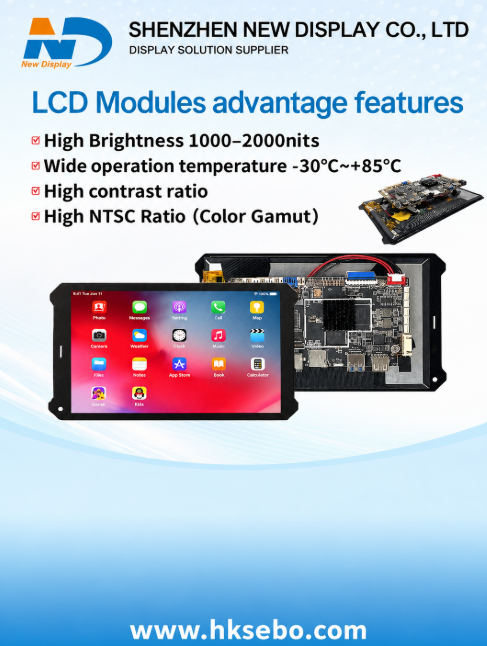
High-Brightness: High-resolution panels run 2″ to 21.5″ at 1920×1080, 2K and 4K, with brightness of 1000 to 2000 nits.
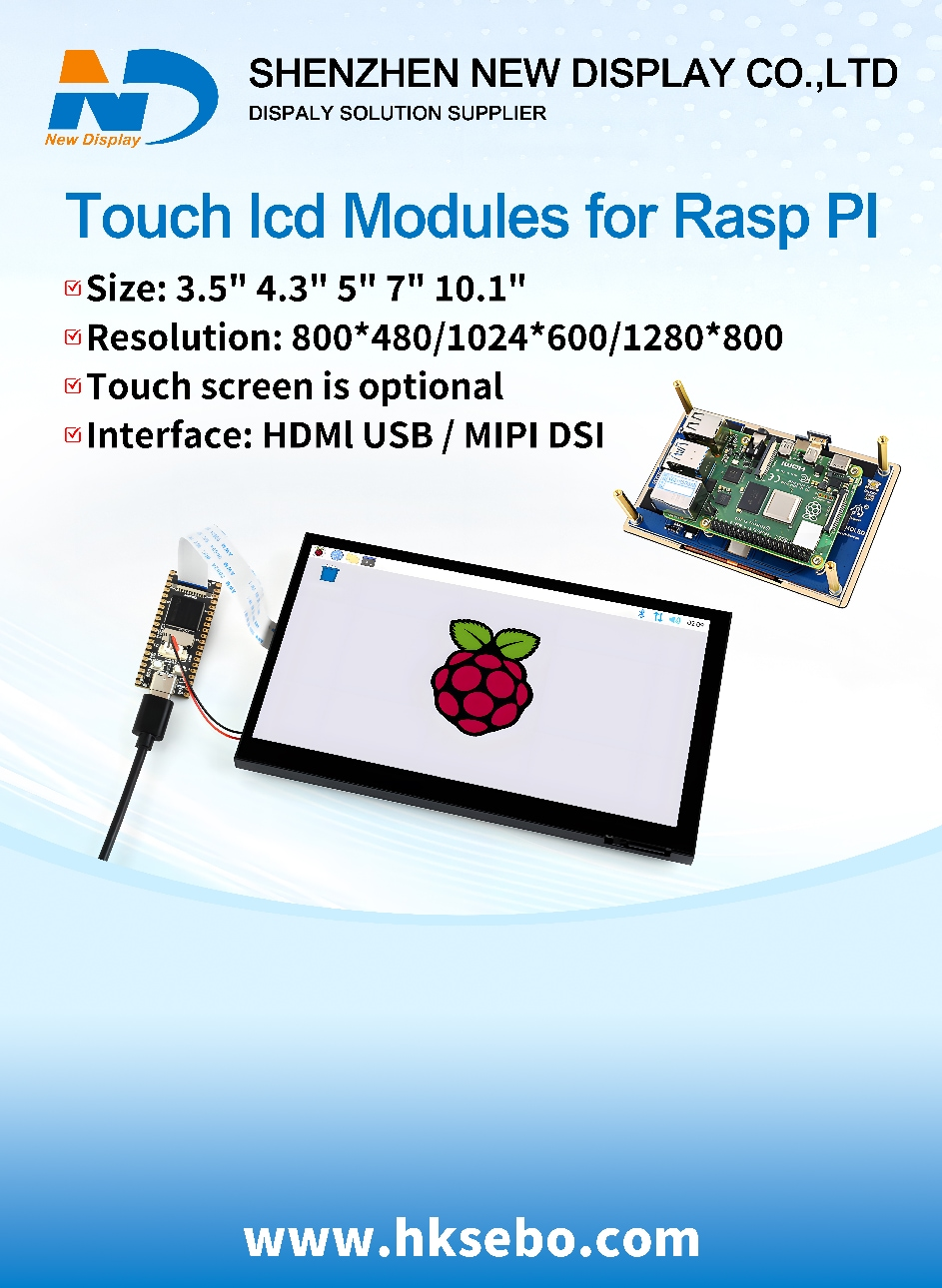
UART Smart LCD: Modules from 2.4″ to 10.1″ carry an onboard processor and memory, expose TTL, RS232 or RS485 serial interfaces, and support resistive or capacitive touch.
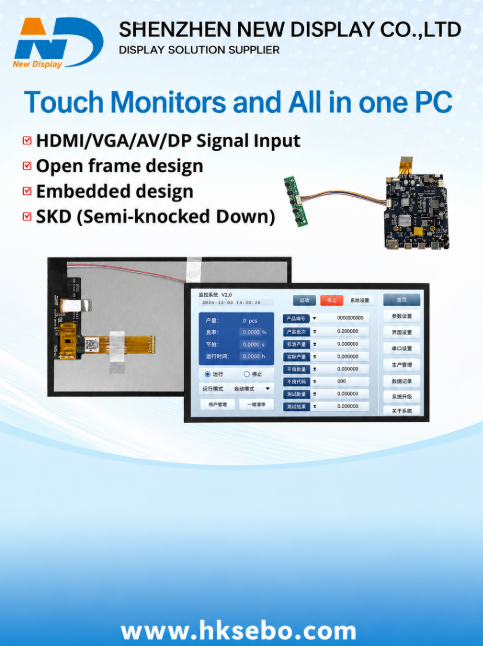
SSD1963-controller modules from 3.5″ to 10.1″ at 800×480 or 1024×600 give legacy MCU-based designs a documented, repeatable upgrade path. Alongside the panels sit resistive and capacitive touch screens on I²C or USB, bonded either with 3M tape or by optical bonding and finished with AG, AF or AR surface treatment; and controller boards accepting AV, VGA, DVI, HDMI, DP and Type-C input while driving MIPI, eDP, LVDS and RGB panels.
Argument one: non-rectangular enclosures are now the norm, not the exception
A designer who needs a round gauge face or a wide instrument strip has historically had three options: mask a rectangular panel behind bezel artwork, pay for a custom glass tool, or abandon the industrial design.
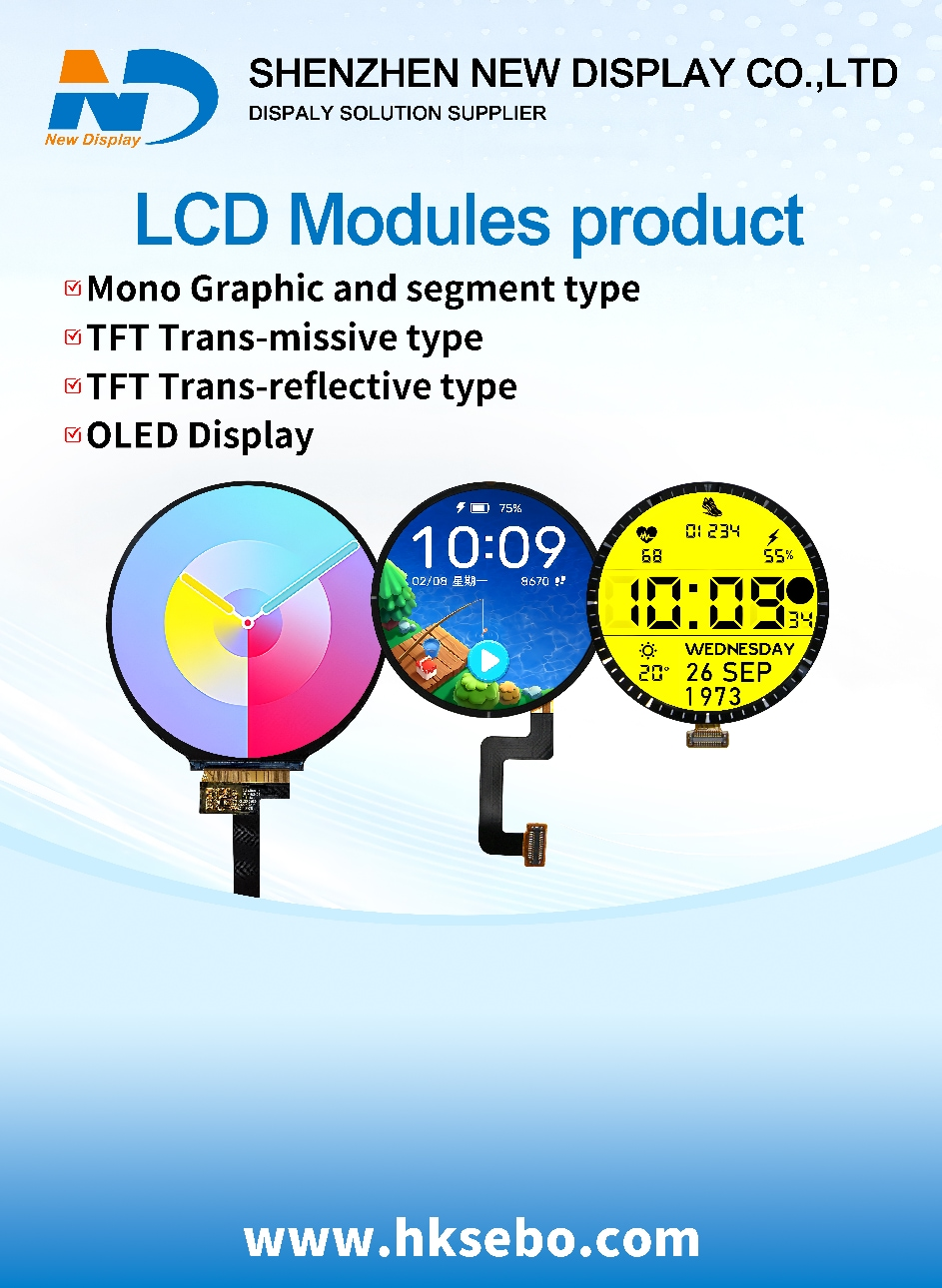
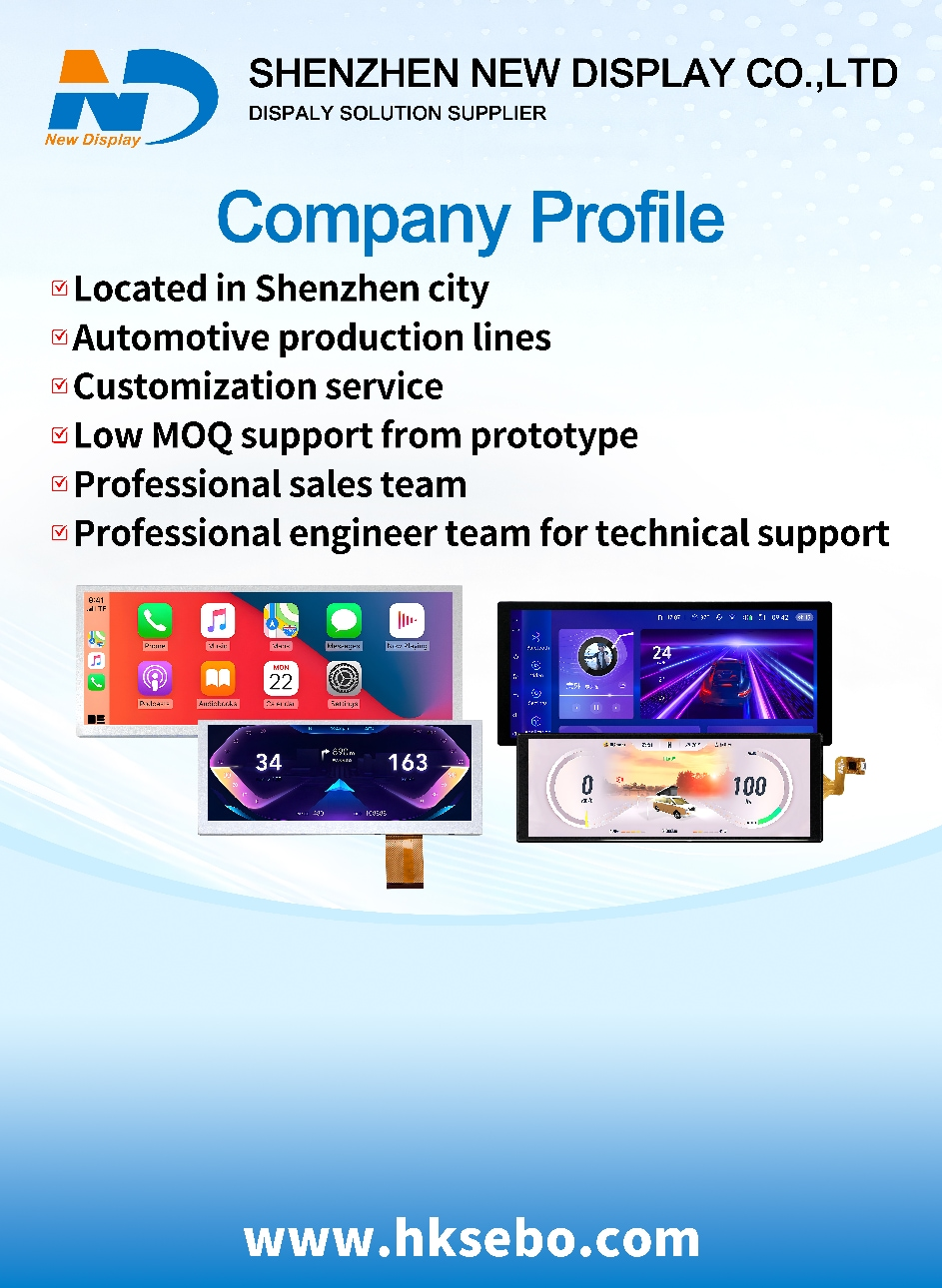
New Display manufactures round LCD displays from 1.28″ to 5″, from 240×240 up to 1080×1080, with full viewing angle and optional touch — sized for circular gauges, dials, control knobs and instrument faces where the display shape is dictated by the mechanical design. The range extends into bar-shape and ultra-wide panels from 2.98″ to 15″, built on MIPI, LVDS or serial interfaces and aimed at automotive dashboards, cluster strips, and bus or metro advertising rails.
The evidence that this is a real category rather than a niche curiosity sits in the company’s standard list, where bar-format panels appear at 5″, 6.86″, 7″, 7.84″, 8.8″, 9.35″, 9.66″, 9.76″, 9.88″, 10.3″, 12.8″, 14.6″ and 15″ — a dozen widths of the same engineering idea, each matched to a different instrument cluster or signage geometry.
Argument two: the interface, not the glass, decides whether a project ships
In practice, most delays in display integration are not optical. They occur at the flex cable. A panel may be electrically perfect and still fail the build because its FPC pitch, pin sequence, connector orientation or backlight drive voltage does not match the customer’s mainboard — and a re-spin of the PCB costs more than the panel ever did.
This is why New Display specifies its customisation service at the interface level: custom LCD backlight, custom LCD FPC and pinout, custom touch panel matched to the display, custom driver board, and a custom adapter PCB that translates the panel interface to the customer’s mainboard connector.
The same logic explains the placement of the driver-board and UART lines. A customer with an HDMI or Type-C source but a MIPI or LVDS panel gets a signal board rather than a new mainboard. A customer with an RS485 bus and no graphics pipeline gets a smart module with an onboard processor.
Argument three: sunlight is a specification, not a marketing claim
Brightness numbers are easy to print and hard to deliver. A 350-nit panel that looks acceptable on a lab bench disappears in a vehicle cab at noon. The measurable fix is emitter output plus optical stack: a brighter backlight, an optically bonded touch layer that removes the air gap and its internal reflection, and an anti-glare or anti-reflective front surface.
New Display’s high-brightness range covers 2″ to 21.5″ at 1000 to 2000 nits with 1920×1080, 2K and 4K resolution, offered alongside optical bonding and AG, AF or AR treatment. The engineering logic is that these three levers — luminance, bonding and surface treatment — must be specified together.
Argument four: low volume is a market segment, not a favour
Industrial and automotive programmes rarely begin at consumer volumes. A first article run of a hundred units, then a thousand, then a re-order after field validation — that is the normal shape of demand.
New Display positions lower MOQ alongside its experienced technical and sales teams as a core advantage, which is consistent with an export footprint spread across five regions rather than concentrated in one.
What a buyer should verify before choosing a custom LCD module supplier
About Shenzhen New Display
Shenzhen New Display Co., Ltd. (brand HKSEBO) is a Shenzhen-based professional LCD display solution provider founded in 2014, manufacturing TFT LCD displays, OLED displays, round and bar-hape panels, UART smart modules, touch panels and LCD driver boards, with ISO 9001 certification and Shenzhen High-Tech Enterprise status. The company exports to more than 40 countries. Product information: www.hksebo.com; enquiries: sales1@hksebo.com.
Post time: Nov-24-2026